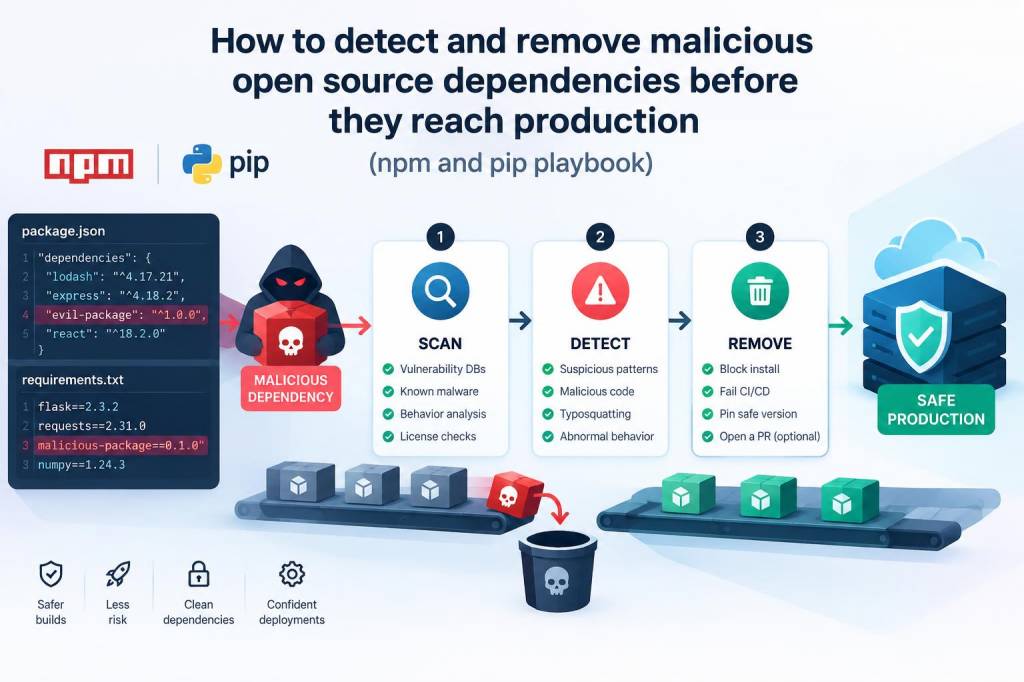

How to detect and remove malicious open-source dependencies before they reach production (npm and pip playbook)

I build and ship software for a living, and one thing I've learned the hard way is that most supply‑chain compromises start small: a tiny, trusted package gets a subtle, malicious change and suddenly you're executing attacker code in production. Whether you work with npm or pip, detecting and removing dangerous open‑source dependencies before they hit production is a practical exercise in automation, hygiene and threat hunting. Below I share a playbook I use with engineering teams to...

Read more...

How to detect and remove malicious open-source dependencies before they reach production (npm and pip playbook)
Guides

How to run a secure, offline multimodal assistant on a mac mini m2 with sub-50ms image responses

11/10/2026

I’ve been obsessed with running capable AI locally for a long time, and getting a truly multimodal assistant — one that understands images and...

Read more...
How to run a secure, offline multimodal assistant on a mac mini m2 with sub-50ms image responses
Cybersecurity

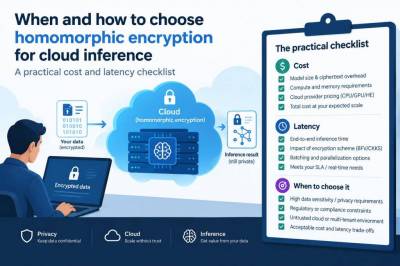
When and how to choose homomorphic encryption for cloud inference: a practical cost and latency checklist

08/10/2026

I’ve been testing homomorphic encryption (HE) in cloud inference projects for a few years now, and every time I talk to engineers or security teams...

Read more...
When and how to choose homomorphic encryption for cloud inference: a practical cost and latency checklist

Latest News from Roctoken Co

How to choose the right small business firewall for hybrid teams

I’ve spent years helping small teams pick tools that actually make work safer and simpler, so when hybrid setups started becoming the norm I quickly realised the firewall conversation had to change. A firewall for a small business in 2025 isn’t just a box at the office edge — it’s the glue between on‑prem users, remote staff, cloud services and SaaS apps. Choosing the right one means balancing security, manageability and cost while...


Read more...

How to build an incident response playbook for a small e‑commerce site

Running a small e‑commerce site means juggling product listings, payment flows, customer support and marketing — all while hoping the infrastructure quietly hums along. When something goes wrong, "let’s fix it" is not a plan. Over the years I’ve helped small teams translate that gut reaction into repeatable actions. Below I’ll walk you through a pragmatic incident response playbook tailored to a small e‑commerce business: what to...

Read more...

Step-by-step: migrating your team from Slack to a self-hosted Matrix setup

I recently led a migration of a mid-sized engineering team from Slack to a self-hosted Matrix setup, and I want to share the step-by-step playbook I used. If you’re contemplating the same move, you likely want more control over data, better federation options, or cost predictability. That’s exactly why we moved. In this guide I’ll cover planning, architecture choices, data migration strategies, day‑to‑day operations, and the...

Read more...

A practical guide to reducing AI hallucinations in customer support chatbots

When I started evaluating chatbots for customer support teams, one thing quickly became clear: hallucinations — confident but incorrect or fabricated responses from an AI — are the single biggest blocker to deploying models at scale. I’ve spent months testing retrieval-augmented pipelines, fine-tuning assistants, and watching support agents roll their eyes at answers that sounded plausible but were flat-out wrong. In this guide I’ll...

Read more...

What to look for when buying a privacy-focused Android phone on a budget

I’ve spent a lot of time testing phones, flashing ROMs and poking around settings to understand what really matters when you want privacy without paying flagship prices. If you’re trying to buy a privacy‑focused Android phone on a budget, you’ll quickly find that “privacy” can mean different things depending on whether you care most about software updates, limiting Google’s reach, hardware protections, or just reducing the number...

Read more...

Which password managers resist phishing and how to configure them correctly

I get asked a lot which password manager will actually protect you from phishing, and the short answer is: some do a lot better than others — but only if you configure them correctly. Over the years I’ve tested and reviewed most major managers (1Password, Bitwarden, LastPass, Dashlane, Keeper, and the major browser-built managers), and the pattern is the same: a tool can only stop phishing reliably if you understand how its autofill and...

Read more...

Understanding model distillation: make your LLM run fast on a laptop without cloud costs

I remember the first time I tried to run a modern language model on my laptop: it was slow, memory-starved, and I spent more time swapping RAM than actually getting useful responses. Since then I’ve tested pruning, quantization, on-device runtimes and — most importantly — model distillation. Distillation is the technique that finally let me run capable models locally without paying cloud fees or sacrificing privacy. In this piece I’ll...

Read more...

Hands-on test: which USB-C hubs actually preserve Thunderbolt performance?

I’ve been pairing laptops, docks and external displays for years, and one recurring frustration is the gap between what manufacturers advertise and the real-world bandwidth you actually get from a USB-C hub when you need full Thunderbolt performance. I set out to test a selection of popular USB-C hubs and docks to answer a simple question: which ones truly preserve Thunderbolt bandwidth for external SSDs, 4K/5K displays and high-speed...

Read more...