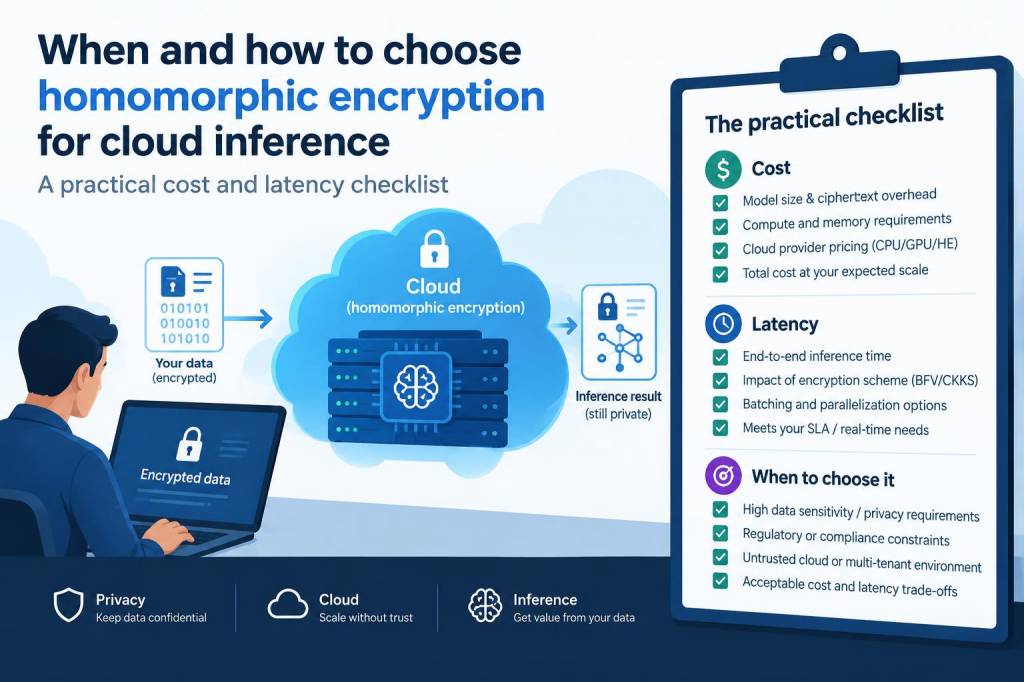
I’ve been testing homomorphic encryption (HE) in cloud inference projects for a few years now, and every time I talk to engineers or security teams they ask the same two practical questions: When should I pick homomorphic encryption over alternatives like secure enclaves or differential privacy? And how will it affect my cloud costs and latency? This article is a hands‑on checklist to help you answer both.
I’ll share the decision points I use when advising teams, the real‑world tradeoffs I’ve measured, and a compact cost/latency checklist you can apply to your own workload. My goal is to make the choice less abstract: HE is powerful, but it’s not a silver bullet. It’s expensive in compute and latency compared with plaintext inference and often more complex to integrate than you expect. That said, for specific threat models it’s uniquely valuable.
Why choose homomorphic encryption for inference?
I think of HE as a targeted tool for a narrow set of requirements. The core promise is clear: run useful computation on ciphertexts so your cloud provider (or anyone operating the inference infrastructure) never sees raw inputs. That’s attractive in scenarios where data confidentiality is a hard constraint rather than a best practice.
Use HE when:
You must protect raw inputs from an honest‑but‑curious cloud operator (or multiple parties) and cannot trust TEEs (trusted execution environments) or legal contracts.Your application requires exact results on encrypted data (not just statistical protections). For instance, private scoring of medical imagery, financial models, or proprietary ML models where you can’t expose either inputs or intermediates.You need cryptographic guarantees that remain robust even if hardware TEEs are later shown to have vulnerabilities.If your threat model is weaker—e.g., you mainly worry about compliance, insider threats, or accidental leakage—alternatives such as TEE (Intel SGX, AMD SEV), MPC (secure multiparty computation), or hybrid approaches might be preferable in terms of cost and latency.
Key tradeoffs I always evaluate
Before choosing HE I run through a short checklist that focuses on three dimensions: security guarantees, performance (latency & throughput), and integration complexity.
Security guarantees: HE protects inputs during computation. It does not hide the fact a computation occurred, nor does it protect model weights unless you explicitly encrypt them. Fully homomorphic encryption (FHE) gives broad expressiveness; leveled/FHE variants restrict circuit depth but are cheaper.Latency vs throughput: HE usually dramatically increases latency per inference. Small batch sizes are particularly painful. However, some schemes and implementations let you amortize cost across batched inputs or perform approximate arithmetic (CKKS) for ML that tolerates quantization.Integration complexity: Converting models to HE‑friendly representations can be nontrivial. Activation functions, branching, and large dense layers often need redesign. Frameworks like Microsoft SEAL, PALISADE, TFHE, or concrete‑ml help, but expect engineering effort.Practical performance observations
Here are the performance patterns I’ve seen repeatedly while experimenting with public HE libraries and cloud VMs:
Inference latency typically increases by 10–1,000x depending on model architecture, HE scheme (CKKS vs BFV vs TFHE), and precision needs. Small neural networks or logistic regression are the easiest to adapt; deep CNNs and transformers are much harder.Throughput can be improved via batching and SIMD-style packing in schemes that support it (CKKS). Packing multiple inputs into one ciphertext reduces amortized cost, but increases coding complexity and memory use.Memory usage rises because ciphertexts are large (often tens to hundreds of KB each). For large models you may run into VM memory limits before compute limits.Bootstrapping (to refresh ciphertexts for deeper circuits) is expensive. Some leveled schemes avoid frequent bootstrapping at the cost of limiting circuit depth; that’s a common engineering trade.Concrete cost & latency checklist
Use this checklist to estimate whether HE is feasible and to pick an approach. I recommend running a short POC before committing.
Step 1 — Define your threat model: Who must not see the inputs? Cloud operator, contractor, other tenants? Do you need to hide model weights too? If you don’t need this level of protection, consider TEEs + disk encryption first.Step 2 — Benchmark a plaintext baseline: Measure latency and throughput for your model on the target cloud instance class. Record memory, CPU/GPU utilization, and cost per 1,000 inferences.Step 3 — Pick an HE scheme by operation: If your model is linear or uses approximate arithmetic, CKKS is common. For exact integer ops choose BFV/BGV. For binary logic TFHE is better but costly for arithmetic. Choose libraries (Microsoft SEAL, Lattigo, Concrete) and test a single layer first.Step 4 — Prototype a minimal POC: Convert core operations (e.g., dot product) to encrypted form and measure latency for a single inference and batch sizes of 1, 8, 32, 128. This will reveal whether batching helps enough to be viable.Step 5 — Measure memory and network impact: Ciphertexts are large. Track ciphertext size and network transfer cost for sending/receiving encrypted inputs and outputs. If you plan serverless or autoscaled functions, check cold start impact.Step 6 — Calculate cost multiplier: From my tests, multiply your plaintext cost by the observed slowdown factor. Example: if plaintext inference costs $0.005 per prediction and HE adds 100x latency/CPU, your rough cost becomes $0.50 per prediction before considering amortization and batching.Step 7 — Consider hybrid designs: If full HE is too costly, think hybrid: encrypt only sensitive features, run the rest in plaintext; or use HE for early private filtering then hand off smaller decrypted batches to normal inference.Step 8 — Plan for scaling and monitoring: HE POCs often succeed at small scale but hit limits when scaled. Monitor latency percentiles, memory paging, and cloud egress/cost. Implement fallbacks if latency SLAs break.Quick reference table — expected order‑of‑magnitude impacts
| Aspect | Plaintext inference | HE (typical) | Notes |
| Latency (single request) | 10–200 ms | 100 ms – multiple seconds (10–1000×) | Smaller models and CKKS with packing are faster |
| Throughput (batched) | 100s–1000s req/s | Reduced, but batching can partially recover throughput | Packing is key; engineering overhead increases |
| Memory per request | KB–MB | 10s–100s KB or more per ciphertext | Memory limits can constrain model size |
| Engineering effort | Low–Medium | High | Model redesign, HE libraries, and testing required |
| Security | Depends (TEEs, contracts) | Strong cryptographic guarantees | Resistant to operator access; quantum safety depends on parameters |
Real‑world patterns I recommend
From multiple projects I've worked on, these practical patterns help teams get value without paying the full HE tax:
Encrypt sensitive features only: If only a subset of input features are sensitive, encrypt them and process the rest in plaintext. This reduces ciphertext counts and circuit depth.Use model distillation: Train a smaller model optimized for HE-friendly arithmetic and lower depth. Distilled models are easier to convert and run faster.Batch aggressively and use packing: Design your inference API to accept batches or pack multiple values into a single ciphertext to amortize expensive ops.Combine with TEEs: For some threat models, encrypt inputs client-side, run light preprocessing in a TEE, then use HE for the most sensitive inner loop. This hybrid can reduce circuit complexity.Negotiate SLAs with stakeholders: Deploy HE behind endpoints that accept higher latency or lower throughput; for interactive apps consider fallbacks to plaintext when consented.If you want, I can help you run through a checklist tailored to your model and workload—tell me your model type (logistic regression, small CNN, transformer), average input size, and your threat model and I’ll sketch a realistic POC plan with likely cost multipliers and recommended libraries.