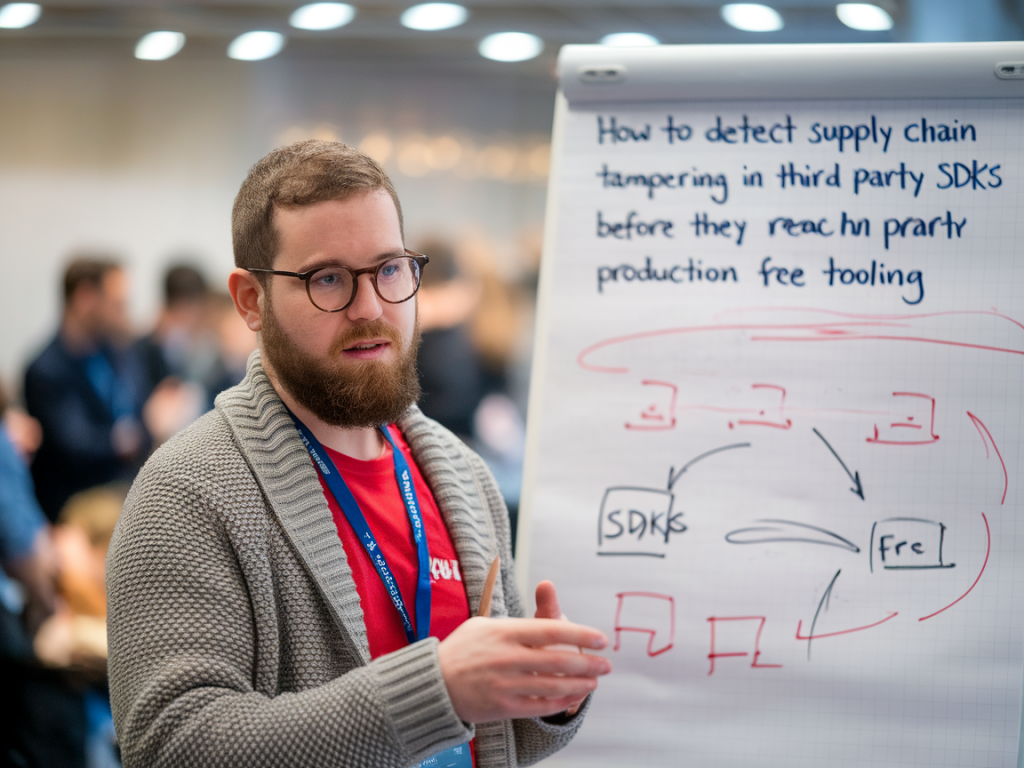
I remember the first time a third‑party SDK caused a late‑night incident: a benign analytics library I’d approved began exfiltrating data after an upstream compromise. Since then I’ve made detecting supply‑chain tampering a standard part of any pre‑production gate. The good news is you can do a lot with free, open tools—SBOM generators, signature verifiers, lightweight static checks and simple binary inspections—to catch suspicious changes in third‑party SDKs before they reach your users. Here’s a practical, hands‑on workflow I use and recommend, plus the tools and commands that make it repeatable in CI.
Why pre‑production checks matter (briefly)
Third‑party SDKs run inside your app’s process and inherit your privileges. A small malicious change in an SDK can do more damage than an app bug. Pre‑production detection focuses on noticing unexpected modifications or bad provenance before code ships, letting you block, investigate or roll back with confidence.
High‑level workflow I follow
Essential free tools and how I use them
Below are the tools I rely on—open source, free, and scriptable so you can automate them in GitHub Actions, GitLab CI, or any CI system.
Command examples:
syft my-sdk.tar.gz -o spdx-json > sdk-sbom.json
Use syft on SDK directories or extracted package files to get a machine‑readable inventory of components and their versions.
Run: grype sbom:./sdk-sbom.json or grype my-sdk.tar.gz. Grype finds known CVEs and is great for a quick safety check of transitive dependencies.
If the vendor signs their release (and they should), cosign verifies the signature and queries Rekor transparency log entries. Example: cosign verify --key
Look for supplied provenance files or SLSA attestations. If the vendor supplies in‑toto or SLSA files, inspect them to see build steps, source commits and builder identities. If not present, treat lack of provenance as higher risk.
Run semgrep rulesets against vendor source to flag suspicious patterns (eval, remote code exec, suspicious crypto). semgrep has community rules for malware and backdoors. Bandit for Python; eslint for JS.
Trivy can enforce policies; Scorecard checks GitHub projects for best practices like signed releases and secure CI. If a package scores poorly, investigate.
For compiled SDKs or native libs, I extract strings (strings lib.so) to spot URLs, IPs or suspicious domains. I compute checksums (sha256sum) and keep them in a small local cache. YARA rules are useful for hunting known indicators (hardcoded C2 domains, obfuscated shellcode).
When something smells off, I drop into Ghidra (free) to inspect imports, obfuscated functions or embedded resources. It’s slower but powerful for a confirmed suspicion.
Concrete sequence I run in CI (example)
Here’s a lightweight pipeline I use inside a pull request check or a pre‑merge job. Replace placeholders with your artifact handling.
1) Download vendor artifact (npm tarball, wheel, AAR, jar, binary) into workspace.
2) Extract artifact and run syft to produce an SBOM:
syft ./extracted -o spdx-json > sbom.json
3) Scan the SBOM with grype:
grype sbom:sbom.json --fail-on high,critical
4) Run semgrep on the extracted source (or decompiled jar):
semgrep --config=auto ./extracted
5) Verify signatures with cosign (if vendor provides signatures):
cosign verify-blob --signature sdk.sig --cert sdk.crt --key
6) Run quick YARA rules and strings on native libs, compute checksum and compare to previously accepted checksum store.
7) Optionally run the SDK in a sandboxed integration test that simulates runtime: start a local network capture and exercise typical API paths to see if unexpected outbound traffic occurs.
Handling missing provenance or failed checks
If signature verification fails or provenance is missing, I follow a conservative path: block for production, open a vendor inquiry, and run deeper inspection locally. Often vendors will provide signed builds and a rekor entry when requested; their responsiveness is itself an indicator of maturity.
Why SBOMs + signatures are the single most useful defenses
SBOMs let you see transitive dependencies at build time; signatures and Rekor entries give you an audit trail. Together they let you detect unexpected binary changes or new dependencies that could indicate tampering. If a vendor won’t provide them, consider raising your procurement requirements—contractual provenance is a security control.
Quick decision checklist I keep
| Check | Action if fail |
| Signature / Rekor entry | Block → ask vendor for signed release and rekor entry |
| SBOM present | Generate one yourself and compare; treat missing as risk factor |
| High/critical CVEs | Patch, pin to safe version or block |
| Semgrep/YARA findings | Investigate locally; decompile/inspect |
| Unexpected network behavior in sandbox | Block + deeper analysis |
I’ve built these checks into GitHub Actions for many projects—generating an SBOM with syft, scanning with grype, running semgrep, and running cosign verify when signatures exist. The whole pipeline can run in a few minutes for most SDKs and prevents painful incidents later.
If you want, I can share a tested GitHub Actions workflow snippet that wires these tools together. I can also help tailor policies (e.g., fail on any package with network‑enabled native code) to your threat model.