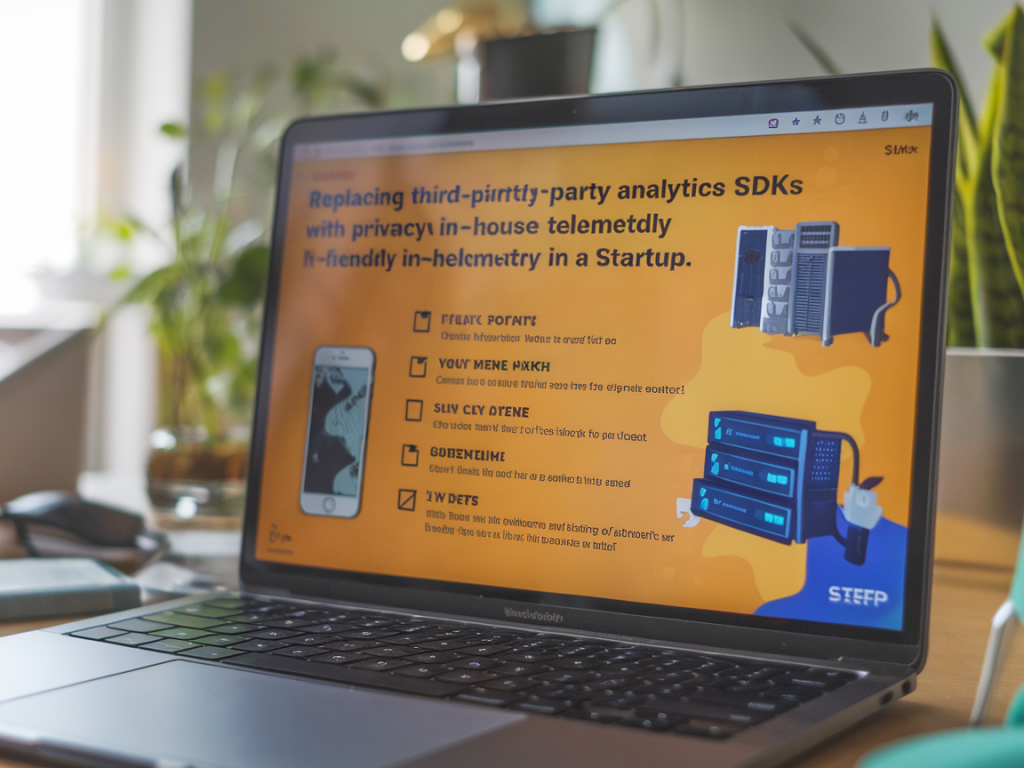
When I helped my last startup cut ties with a large third‑party analytics vendor, it started as a privacy and cost conversation and ended up reshaping how we measured product success. Replacing an off‑the‑shelf SDK with an in‑house telemetry pipeline is more than engineering work: it’s a product, legal and operations effort. Below is a playbook I used and refined—practical steps, pitfalls, and tradeoffs you can apply whether you’re a two‑person team or a 50‑engineer shop.
Why go in‑house? Quick decision checklist
Before you commit, be honest about motives and constraints. I find the following checklist helps avoid wishful thinking:
- Privacy & compliance: Are you bound by GDPR, CCPA, or working with sensitive user cohorts where third‑party tracking is problematic?
- Cost: Are SDK vendor fees or overage charges significant or unpredictable?
- Data control: Do you need raw events for custom models, or to avoid vendor lock‑in?
- Speed to insight: Can you accept building dashboards and ETL versus instant vendor dashboards?
- Engineering capacity: Do you have 1–2 engineers to own this for several sprints?
If more than two of these are “yes,” in‑house telemetry can be worth it. If you're lacking engineering bandwidth or need instant exploratory analytics, hybrid approaches (self‑hosted Open Source analytics like PostHog or Plausible, or a fenced vendor plan) can be interim steps.
High‑level architecture I recommend
My preferred minimal architecture for startups balances flexibility with low operational overhead:
- Client instrumentation layer (lightweight SDK you control)
- Ingest API (managed as a small service behind a gateway)
- Message queue or buffer (Kafka, Redis Streams, or even S3 for batch)
- Processing & enrichment workers (event validation, PII scrubbing, sessionization)
- Storage: analytics warehouse (ClickHouse, BigQuery, Snowflake) and raw event lake (S3)
- Visualization & dashboards (Metabase, Superset, Looker)
This lets you keep raw data for experiments while serving curated aggregates to product and marketing teams. I’ve used ClickHouse for fast product metrics at scale and BigQuery when the budget allowed predictable serverless queries.
Step 1 — Map current telemetry and dependencies
Start by inventorying what the vendor SDK currently does:
- Which events are sent automatically (crashes, device info, session start)?
- Which product events are custom (signup, purchase, feature toggles)?
- Which downstream tools rely on vendor data (ads platforms, marketing automation, data warehouse)?
- What personal data is collected and sent (IP, device IDs, emails)?
Export sample event payloads. I asked my frontend and mobile teams to log real payloads for a week and stored them in a shared folder—this made it obvious which fields we could drop or must keep.
Step 2 — Define core events and schema
Don’t replicate every field. Define a minimal event model that satisfies product, analytics and legal needs. I use a simple specification for each event:
- event_name — canonical string e.g., "signup.complete"
- timestamp — ISO 8601
- user_id / anon_id — choose one canonical identifier
- properties — typed object with whitelisted keys
- context — device or app version metadata minimized for privacy
Document allowed value types and cardinality limits (avoid free‑form high‑cardinality strings in properties). Add schema versions to support forward compatibility.
Step 3 — Design the client SDK
Build a tiny client library aimed at being easy to audit and maintain. Key principles I follow:
- Minimal payloads: only send fields on the whitelist; strip PII locally.
- Configurable sampling: allow server‑controlled sampling rates to limit cost.
- Offline support: simple batching and backoff to avoid impacting UX.
- Opt‑out hooks: expose an API to opt out per user or by consent flags.
- Small & dependency‑free: keep it under a few KBs and no heavy runtime libs.
For web, I wrote a 200–400 line JavaScript module; for mobile, a lightweight Swift/Kotlin wrapper. Use feature flags to toggle between vendor and in‑house during migration.
Step 4 — Build an ingest API and validation layer
Your ingest endpoint is the gatekeeper. Implement:
- Authentication: API key per app or per release channel
- Rate limiting and basic DOS protection
- Payload validation against the schema with clear error messages
- PII scrubbing and hashing for any identifiers that must be preserved in hashed form
Keep the ingest service stateless and idempotent; push raw validated events into an append‑only store (S3) and a fast stream (Kafka/Redis) for near real‑time pipelines.
Step 5 — Processing, storage and privacy controls
Processing workers enrich events—geolocation from IP (or choose not to), device breakdowns, session stitching—and produce two outputs:
- Raw event archive: compressed JSONL in a secure S3 bucket with strict ACLs and lifecycle rules
- Analytics tables: compact, schema‑mapped tables in your warehouse for dashboards and BI
Apply privacy transformations here: drop IPs, truncate timestamps, hash or salt identifiers. I recommend a "privacy pipeline" that applies GDPR and retention rules before events land in analytics tables.
Step 6 — Dashboards, monitoring and parity testing
Build dashboards to replace what teams used in the vendor UI. Don’t try to beat them initially—replicate key KPIs first (MAU, conversion funnels, retention cohorts). Parallel run both systems for a few weeks and compare counts.
| Metric | Vendor | In‑house | Acceptable delta |
|---|---|---|---|
| Daily Active Users | 12,420 | 12,100 | ±5% |
| Signup conversions | 3.8% | 3.7% | ±0.2% |
Where deltas exceed bounds, debug: mapping mismatches, sampling differences, sessionization logic. I logged event IDs and used join queries to find causes quickly.
Step 7 — Migration and cutover plan
A staged migration reduces risk:
- Release client SDK with dual‑send mode (vendor + in‑house) toggled by flag.
- Start with internal users and beta cohorts; watch performance and completeness.
- Enable in‑house as default for new users while existing users remain on vendor for a month.
- Run comparison metrics; once within thresholds, flip off vendor sending for a percentage of users gradually.
- Finally, disable vendor SDK after legal confirms contract termination conditions and data deletion.
Keep a rollback plan: ability to re‑enable vendor sending if a critical metric breaks.
Operational considerations and costs
In‑house reduces vendor lock and per‑event fees but introduces operational cost. Track these buckets:
- Engineering hours for SDK and pipelines
- Cloud storage and compute for processing (S3 + EMR/BigQuery / ClickHouse nodes)
- Ongoing maintenance (schema migrations, privacy audits)
Tip: start with a low‑cost stack—S3 for raw events, serverless Lambdas or small Kubernetes jobs for processing, and a managed warehouse. You can optimize and self‑host (ClickHouse) later when volume and cost justify it.
Security, compliance and governance
Treat telemetry as a first‑class data product:
- Encrypt data at rest and in transit
- Restrict access with IAM roles and audit logs
- Document data lineage and retention—how long raw events live and who can access them
- Provide data deletion paths for DSARs (Data Subject Access Requests)
I implemented a pipeline that can purge user‑related events from the analytics tables and mark raw archives for redaction—this saved headaches during GDPR inquiries.
Common pitfalls I’ve seen
- Over‑instrumentation: capturing high‑cardinality strings kills performance and storage. Be deliberate about keys.
- Hidden dependencies: marketing automations or ad platforms that expected vendor IDs—map and migrate these first.
- Lack of observability: no alerts on ingest failures leads to data gaps. Add SLOs and monitor pipeline liveness.
- Scope creep: building a full analytics product instead of solving your immediate reporting needs—prioritize the 20% of metrics that drive 80% of decisions.
Replacing a third‑party analytics SDK isn’t purely an engineering task; it’s a cross‑functional initiative requiring product discipline, legal hygiene and an ops mindset. If you keep the first iteration simple, protect privacy by design, and iterate based on real metric parity tests, you’ll end up with telemetry that’s cheaper, more private and tuned to your startup’s needs.